 Sideline vs. Renamr
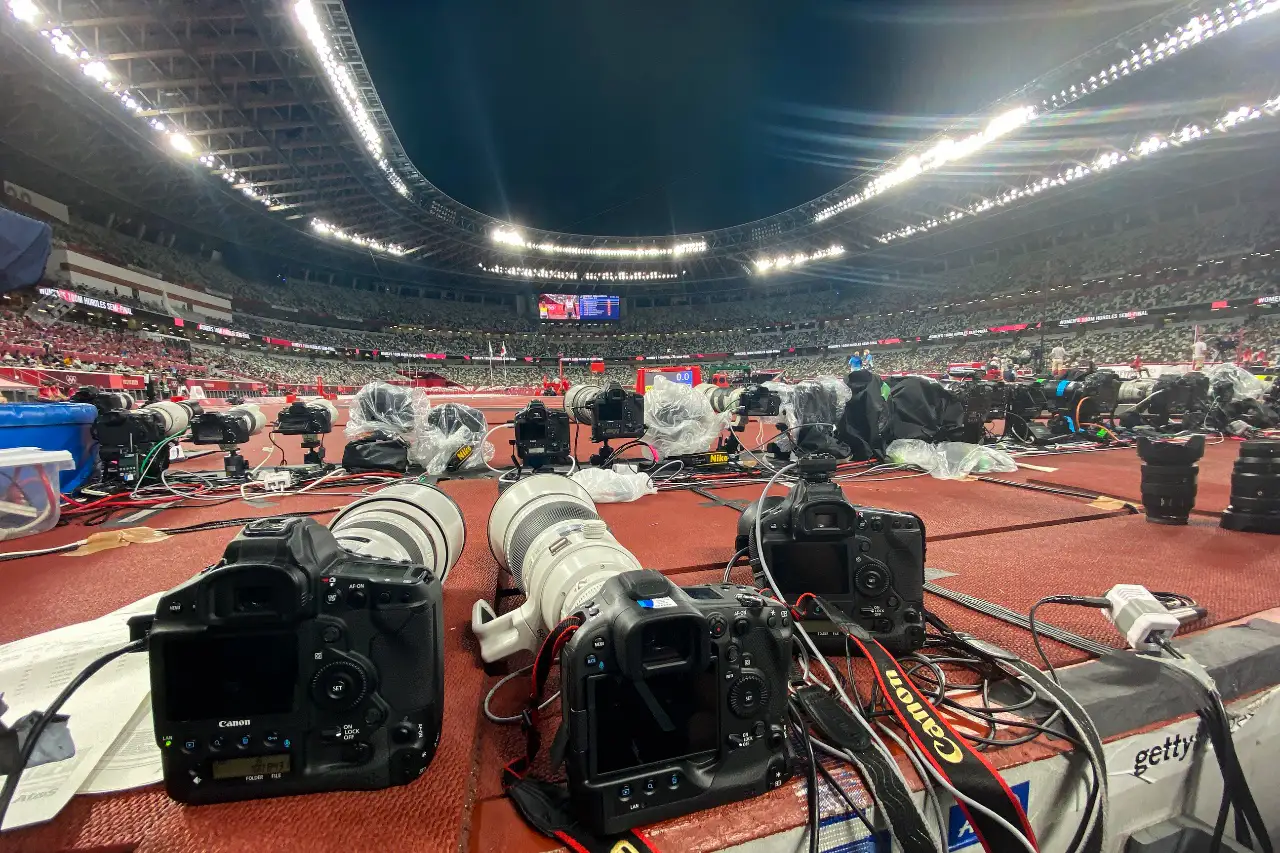
SPORTS PHOTOGRAPHY WORKFLOW
The Modern Sports Photography Workflow (2026)
A modern sports photography workflow isn't something you think about when everything goes well.
You notice it when things go wrong.
When a photo goes out with the wrong name.
When an editor texts asking where the images are — while the game is still going.
When you're trying to caption on a laptop balanced on your knees with spotty internet and a lineup change you didn't catch.
In 2026, sports photography isn't just about making pictures.
It's about moving information accurately and quickly under pressure.
This guide breaks down what a modern sports photography workflow actually looks like — not in theory, but in practice — and why each step exists.
Why Workflows Break (and Why That Matters)
Most photographers don't choose bad workflows. They inherit them.
A workflow that worked when:
- You shot one team
- Deadlines were after the game
- Editors only needed a handful of selects
…starts to collapse when:
- You shoot multiple sports or levels
- Images are published live
- Captions are reused everywhere (web, social, wire)
The result isn't usually chaos.
It's subtle friction:
- You're slower than you should be
- You double-check everything because you don't trust your system
- You fix the same mistakes repeatedly
A modern workflow exists to remove that friction before it costs you trust.
The Core Idea: Reduce Thinking When Thinking Is Expensive
During a live event, your brain is already doing too much:
- Tracking the game
- Anticipating moments
- Managing gear
- Watching the clock
A good workflow removes decisions from those moments.
A bad workflow asks you to:
- Remember roster details
- Rebuild Photo Mechanic code replacement files
- Guess jersey numbers
- Fix captions after delivery
The difference between professionals isn't talent — it's how much thinking their system forces on them at the worst possible time.
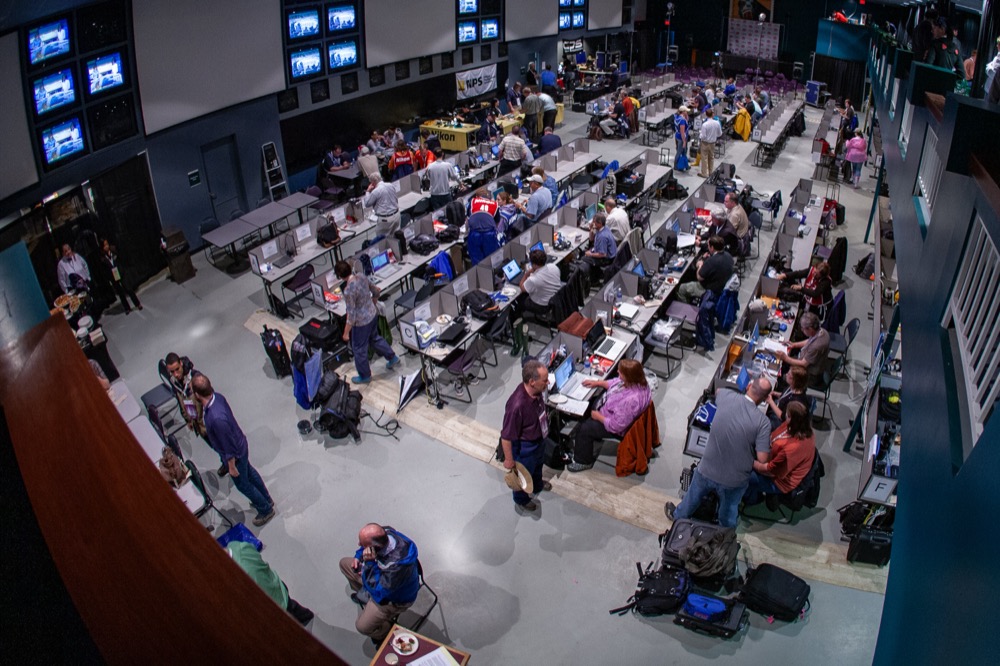
The Media Center for the Kentucky Derby at Churchill Downs. When time is of the essence, a good workflow is essential.
Capture: Shoot for the Caption, Not Just the Frame
Here's a familiar scenario:
You shoot a great action frame — peak moment, clean background — but the player's number is hidden.
You think it's the starting quarterback, but you're not 100% sure.
Now that uncertainty follows the image through the entire workflow.
Experienced sports photographers internalize this quickly:
They don't just shoot for aesthetics — they shoot for identifiability.
That means:
- Waiting half a beat for a clearer angle
- Shooting sequences that show the number before or after the peak
- Prioritizing moments editors can confidently caption
A clean capture phase reduces:
- Guessing later
- Caption review time
- Editorial back-and-forth
No tool can fix ambiguity created at capture.
Ingest: Stop Treating It Like a Single Event
Old model:
Game ends → copy cards → start working
That model fails the moment images are needed before the final whistle.
Modern workflows treat ingest as continuous.
Real-world examples:
- Swapping cards during timeouts
- Ingesting at halftime
- Background transfers while shooting the second half
- Remote editors accessing folders as they populate
The earlier photos exist in your system, the more flexible you become:
- Someone else can start captioning
- You can deliver while still shooting
- Editors can select before the game ends
This isn't about fancy tech — it's about time leverage.
Culling: Where Speed Is Actually Won
Culling is where many photographers slow themselves down without realizing it.
A common mistake: "I'll just shoot everything and sort it out later."
In reality, captioning is the slowest step.
Every image you don't have to caption because you were selective saves far more time than any shortcut later.
Professionals learn to cull with intent:
- Is this image likely to be published?
- Does it add something new?
- Is the moment clear enough to caption confidently?
In real workflows, photographers often caption only 10–20% of what they shoot.
That discipline compounds speed everywhere else.
Captioning: Where Reputations Are Made (or Lost)
A bad edit is subjective. A bad caption is factual.
That's why captioning is the most stressful part of the workflow — especially under deadline.
Traditional captioning relied on:
- Manual typing
- Code replacements
- Printed rosters
- Memory
Those systems worked, but they were brittle.
If a player changed numbers, if two athletes shared a number, or if a late roster update happened – something would break. You didn't just slow down — you risked being wrong.
From Shortcuts to Structured Roster Data
This is where modern workflows quietly diverge.
Instead of starting with text shortcuts, they start with structured roster data:
- Who is on the team
- What number they wear
- What position they play
- Which team they belong to
When captioning is driven by rosters instead of flat text files:
- Setup happens once, not every game
- Duplicate numbers are manageable
- Mid-game changes are less disruptive
This is why roster-based systems exist at all — not because photographers want more tools, but because manual prep doesn't scale.
That's why we built Sideline's Roster Manager: removing repetitive setup so captioning stays accurate under pressure.
Review: The Step That Separates Pros From Amateurs
Here's a real scenario:
- You deliver images during halftime.
- Everything looks fine.
- Later, an editor flags a misidentified player.
That correction takes longer — and feels worse — than if it had been caught immediately.
Many workflows skip review because:
- It feels redundant
- It feels slow
- It used to be painful
But skipping review doesn't save time — it just moves the cost later.
Modern workflows build in fast, focused review:
- Confirm names
- Fix edge cases
- Adjust phrasing
- Ensure consistency
When review is quick and centralized (as with Caption Review), it becomes a safety net instead of a bottleneck.
Editing: Serve the Deadline, Not the Ego
Under deadline, editing has one job: Make the image usable immediately.
That means:
- Clean exposure
- Consistent color
- Straight horizons
- No distractions
It does not mean:
- Perfect skin tones
- Creative crops
- Artistic flourishes
Experienced photographers know that you can always re-edit later, but you can't deliver late.
Delivery: No Longer an Afterthought
Delivery used to mean "upload after the game."
Now it often means:
- Photos during play
- Photo galleries available in real time
- Editors selecting while you're still shooting
This shift breaks traditional FTP-only workflows.
Modern delivery systems exist because photographers need:
- Speed
- Reliability
- Access without server setup
- Fewer points of failure
That's the role of Sideline Live — not just transferring files, but making images available when they still matter.
A Realistic 2026 Workflow (End to End)
Putting it all together, a modern workflow often looks like this:
- You shoot with clarity and intent
- Images ingest continuously
- You cull aggressively
- Captions are generated from roster data
- You review and correct quickly
- You edit only selects
- Images are available in real time before the moment passes
Nothing here is flashy - it's intentional.
Why Most Workflows Fail Under Pressure
They fail because they were built for calm conditions.
Real sports photography involves:
- Fatigue
- Poor internet
- Roster surprises
- Tight timelines
- Divided attention
A professional workflow survives those conditions.
If your workflow only works when everything goes right, it's not finished.
Final Thought
The modern sports photography workflow isn't about automation for its own sake.
It's about protecting your attention when attention is scarce.
When your workflow is right:
- You think less
- You move faster
- You make fewer mistakes
- Editors trust you more
That trust — not gear or software — is what compounds careers.